One of the biggest traps editors fall into is believing a video is never truly finished. You export it, watch it back, and suddenly your brain starts searching for things to change: “Maybe this cut should be faster.” “What if I changed the music?” “Maybe this transition could hit harder.” “I think the color needs more work.” Before long, you’re 20 revisions deep making changes that don’t actually improve the video anymore, they just make it different.
I used to struggle with this constantly. Not because my edits were bad, but because I never defined what “done” actually meant.
Eventually, I created a simple mental checklist that helped me finish projects confidently without endlessly tweaking small details. Here’s the framework:
Does the Video Achieve Its Purpose?
Every video has a job. Before judging details, ask yourself: “Did this video accomplish what it was supposed to do?”
A talking-head YouTube video and a product prelaunch video shouldn’t be judged the same way because they serve different purposes. Some videos are meant to retain attention, create emotion, explain clearly, sell something, entertain quickly, or build atmosphere.
If the core objective works, the edit is already successful. A lot of editors obsess over perfection while ignoring effectiveness.

Nothing Should Pull the Viewer Out
One of the strongest signs that an edit is finished is when nothing breaks immersion while watching your final export. Pay attention to moments that feel awkward, break immersion, drag too long, sound distracting, or look unintentional. Not every frame needs to be flashy.
The experience just needs to feel smooth and intentional. Good editing often feels invisible. If the viewer stays emotionally connected from beginning to end, you’ve done your job.
Stop Editing From Anxiety
A dangerous habit many editors develop is revising out of uncertainty rather than actual necessity. It usually sounds like this: “Maybe it’s not good enough yet.” “What if someone notices this?” “Maybe I should add more effects.” “Maybe another revision will fix the feeling.”
But endless revisions rarely solve unclear direction. Most of the time, they come from fear of finishing. At some point, you have to trust your instincts.
Different or Better
This lesson completely changed the way I edit. Just because a new version feels fresh doesn’t mean it’s actually improved. Editors confuse novelty with quality all the time. You tweak a transition, swap the music, or change the pacing. Suddenly, the edit feels “new,” so your brain assumes it’s better, but often, you simply created another version, not a stronger one.
Create Your Own Definition of “Done”
You need standards before you even start editing. For example, my video is done when the pacing feels intentional, the audio is clean, the story is clear, no moment feels distracting, the emotion lands properly, and I can watch it without wanting to fix obvious problems. That’s it. Without a clear definition of done, your brain keeps searching forever. And when your standards are unclear, revisions become endless.
One Thing That Improved My Editing Process
One part of my workflow that helped me massively was separating thinking from editing. Before I start the hardest part of a project, adding visuals, music, sound design, and pacing, I first prepare the project itself.
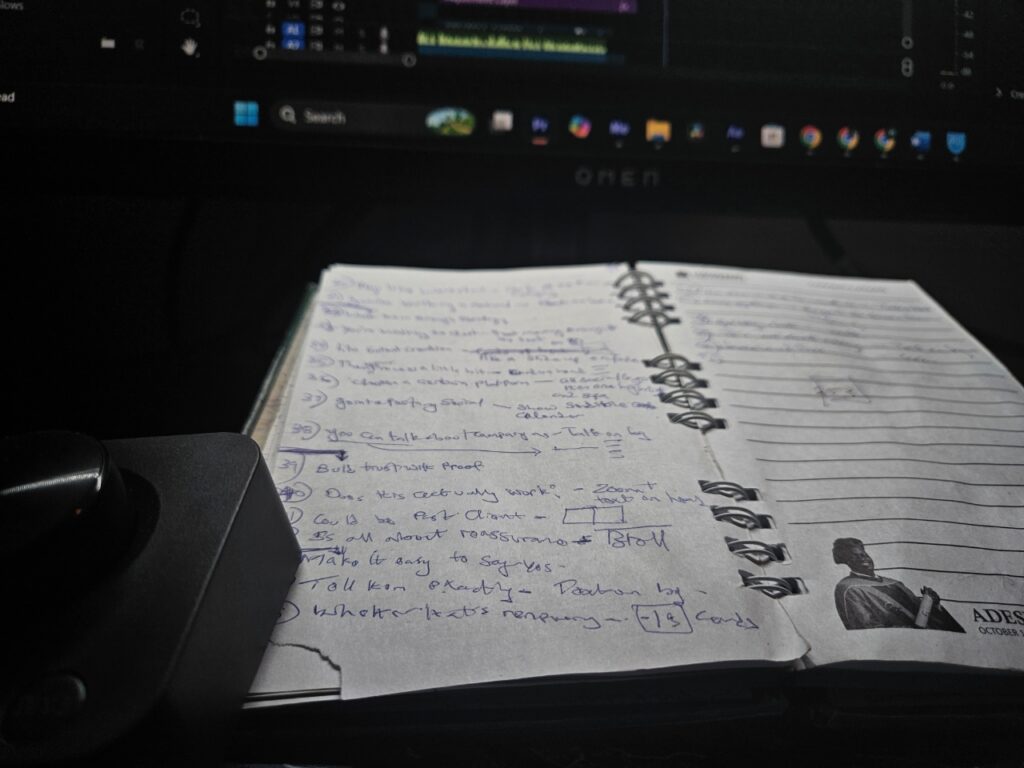
I organize everything by creating all my bins and sequences, then I make a rough cut using the original footage. After that, I leave my desk completely. I take my jotter, a pen, and my phone so I can read the script, then I sit somewhere away from my workspace. That distance matters more than people think.
Once I’m away from the timeline, I can think creatively instead of reacting to what’s directly in front of me. This is usually where I brainstorm visual ideas, music, sound design moments, pacing decisions, and phrases that need emphasis. I write everything down first.
So when I return to my desk, I already know what the video needs. At that point, I either download the assets, create visuals from scratch, or gather music and sound effects. Then I begin editing properly.
That process removes a lot of uncertainty because I’m no longer guessing my way through the edit. I’m executing a vision I’ve already thought through.
Finish More Videos
Ironically, finishing more projects improves your editing faster than endlessly polishing one project. Every completed video teaches you better pacing, better instincts, better storytelling, faster decision-making, and stronger confidence. Perfectionism slows growth, while completion accelerates it.
The goal isn’t to make a perfect video, but to make a video that works because at some point, you stop asking, “What else can I add?” and start asking, “Does this already do what it’s supposed to do?” and if the answer is yes, export it and move on to the next one.
I work with individuals and businesses to create videos that resonate by combining storytelling, thoughtful editing, and a creative touch, all with attention to detail, creativity, and a seamless collaborative process. More about me
Leave a Comment